
Overview
9 days/ 8 nights
places covered: Thimphu, Paro
Embark on the Himalayan Trail Expedition
Witness breathtaking mountain vistas, explore vibrant local cultures, and immerse yourself in Bhutan’s serene and spiritual landscapes. This journey promises an unforgettable adventure through the awe-inspiring beauty of the Himalayas — a perfect blend of natural splendor and cultural discovery.
Itinerary
Day 1: Arive paro, travel to Thimphu Valley
our journey begins with one of the most spectacular mountain flights in the world, offering panoramic views of towering Himalayan peaks such as Everest, Kanchenjunga, and Makalu. As you approach Bhutan, you’ll be welcomed by the sight of the country’s own majestic snow-capped mountains — Jhomolhari, Jichu Drake, and Tserimgang. The flight crosses over the lush southern foothills known as the “Dwars” — natural gateways that transition from the Indian plains to the towering Himalayan ranges.
Upon arrival at Paro International Airport and completion of formalities, you will be warmly received by your local guide. From here, enjoy a scenic drive to Thimphu, Bhutan’s charming capital — a unique city where tradition seamlessly intertwines with modern life.
The remainder of the day is at leisure. You may wish to relax at your hotel or take a casual stroll through the vibrant streets of Thimphu to soak in its atmosphere.
In the evening (time permitting), visit the magnificent Tashichho Dzong, an imposing fortress that houses the throne room of His Majesty the King, key government offices, and the summer residence of the Chief Abbot and central monastic body. If your visit coincides with a working weekday, try to catch the ceremonial hoisting of the National Flag and the March of the Royal Guards — a rare and symbolic sight.
Overnight at Hotel in Thimphu.
Day 02: Thimphu City
Thimphu — Bhutan’s capital — is perhaps the most unique capital city in the world. Nestled in a tranquil valley, it serves as the country’s political and administrative hub and is home to the Royal Family, civil service, foreign diplomatic missions, and several internationally funded development agencies.
Today, embark on a full day of cultural exploration and sightseeing in the vibrant Thimphu Valley. Highlights include:
Buddha Dordenma
Perched atop a hill, this massive 51.5-meter statue of Sakyamuni Buddha is one of the tallest in Asia. The site offers panoramic views of Thimphu and the surrounding mountains — a perfect spot for reflection and photography.National Memorial Chorten
A revered landmark dedicated to world peace and prosperity. It was built in memory of the Third King, His Majesty Jigme Dorji Wangchuck (the Father of Modern Bhutan), and is a spiritual center frequented by locals offering prayers and circumambulating the stupa.Folk Heritage Museum & Textile Museum
These museums provide fascinating insights into Bhutan’s traditional lifestyle, weaving practices, and rural culture. (Note: Closed on Saturdays, Sundays, and Government Holidays.)Institute for Zorig Chusum (Painting School)
This institute offers a six-year course in Bhutan’s 13 traditional arts and crafts. Visitors can observe students practicing wood carving, embroidery, thangka painting, and more.
(Closed on Sundays and Government Holidays; open Saturdays from 10:00 AM–12:00 PM.)Handicrafts Emporium
Operated by the government, this store features an extensive selection of locally made handicrafts, including hand-woven textiles, wood carvings, and books on Bhutanese culture and Buddhism.National Library of Bhutan
Home to an invaluable collection of ancient Buddhist texts, scriptures, and manuscripts, some dating back centuries.
(Closed on Saturdays, Sundays, and Government Holidays.)
In the evening, take a relaxing stroll along Norzin Lam — the main street of Thimphu — lined with shops, cafés, and artisan stalls.
Overnight at Hotel in Thimphu.
Day 03: Travel to Punakha and Exploration
After early breakfast, transfer to Punakha. Drive up to Dochu-la pass (3,088m/10,130ft) and stop here briefly to take in the view and admire the chortens, Mani walls, and prayer flags which decorate the highest point on the road. If skies are clear, the high Himalayan peaks towards the North East will be revealed in all their glory. On a clear day, the following peaks can be seen from this pass (left to right): Masagang (7,158m), Tsendegang (6,960m), Terigang (7,060m), Jejegangphugang (7,158m), Kangphugang (7,170m), Zongaphugang (7,060m) a table mountain that dominates the isolated region of Lunana, and finally, Gangkar Puensum, the highest peak in Bhutan at 7,497m. On the way, visit Semtokha Dzong, built in 1627 and the oldest fortress of the kingdom, which now houses the Institute for Language and Cultural Studies.
We will then continue our trip to Punakha.
Until 1955 Punakha served as the capital of Bhutan and it is still the winter seat of the Je Khenpo (Chief Abbot). Visit the Chimi Lhakhang; the auspicious fertility monastery built in 1499 and a temple dedicated to the “Divine Madman”, an eccentric monk from the 16th century famous for many his many amusing, Rabelaisian folklore stories and drive back to the Hotel.
Following the hike you will drive back up the valley towards Khuruthang passing Punthsho Pelri Palace and several other winter homes of the royal family before reaching the impressive Punakha Dzong, the Dzong built in 1637 by Shabdrung Ngawang Namgyal to serve as the religious and administrative center of the region. Damaged over the centuries by four catastrophic fires and an earthquake, the Dzong has been fully restored in recent years by the present monarch. It is open for visitors during the Punakha festival (early spring) and in the summer months, after the monk body has returned to Thimphu. The Dzong is placed strategically at the junction of the Pho Chu and Mo Chu rivers. This ancient fortress is the winter residence of the monastic order’s head and still serves as the administrative headquarters for the Punakha region.
Balance of the day at leisure.
Overnight at Hotel
Day 04: Travel to Bumthang valley and Explore
Today’s journey to Jakar in the Bumthang Valley is long but undeniably rewarding. Traveling along Bhutan’s only east-west highway, you’ll be treated to breathtaking views of terraced farmlands, deep river gorges, and traditional farmhouses seemingly clinging to the mountain slopes — a true showcase of Bhutan’s rugged yet captivating terrain.
En route, you will stop at Trongsa, a historically significant town and the ancestral seat of Bhutan’s royal family. Time permitting, you may visit the magnificent Trongsa Dzong, an architectural marvel perched high above the Mangde River. This fortress-monastery often echoes with the chants of novice monks and the sound of sacred musical instruments such as horns, flutes, and drums.
Continuing eastward, the road ascends over the scenic Yotong La Pass (3,425 m) before descending into the Chhume Valley, renowned for its traditional Yathra weaving. This is a wonderful opportunity to explore roadside stalls and local workshops where artisans craft intricate woolen textiles using age-old techniques passed down through generations.
Upon arrival in Jakar, check in at your hotel. The remainder of the day is free to relax and enjoy the serene surroundings.
Overnight at Hotel in Bumthang.
Day 05: bumthang Valley Exploration
Bumthang, often referred to as the spiritual heartland of Bhutan, is a collective name for four distinct valleys — Chumey, Choekhor, Tang, and Ura — ranging in elevation from 2,600 to 4,000 meters (8,530–13,125 feet). This region is home to some of the country’s most ancient and revered Buddhist monasteries and temples, each echoing centuries of devotion and spiritual practice.
Three-Temples Valley Walk:
Begin your day with a visit to Jambay Lhakhang, one of the oldest temples in Bhutan, constructed in the 7th century by the Tibetan King Songtsen Gampo. It is believed to be one of 108 temples built across the Himalayas to subdue malevolent spirits.
From here, take a gentle walk through serene farmlands to Kurjey Lhakhang, a sacred temple complex built against a cliffside where Guru Padmasambhava meditated in the 8th century. The temple contains a rock with the imprint of his body and is considered one of the most venerated pilgrimage sites in Bhutan.
Both temples are beautifully situated along the banks of the Chamkhar Chhu (river). Cross a traditional suspension bridge to continue the walk through quaint villages and fields, soaking in the calm rural atmosphere.
Farmhouse Lunch Experience:
Enjoy a traditional farmhouse lunch with a local family. You’ll be treated to a selection of Bumthap cuisine, highlighting ingredients like buckwheat — a staple crop of the region — alongside other Bhutanese favorites.
After lunch, walk to Tamshing Lhakhang, founded in 1501 by Terton Pema Lingpa, a prominent spiritual treasure revealer and believed to be the incarnation of Guru Rinpoche. The temple houses rare and sacred murals dating back to the early 16th century.
Conclude the day with a visit to the Red Panda Brewery and Bumthang Cheese Factory, known for producing Swiss-style cheeses and locally brewed beer. (Please note: both are closed on Sundays and government holidays.)
Overnight at Hotel in Bumthang.
Day 06: Travel to Punakha
Today’s journey takes you back to Punakha, retracing the dramatic landscapes of central Bhutan. Though the drive is long, the route offers ever-changing scenery — from sweeping mountain vistas and winding river valleys to remote villages perched along forested slopes.
Enjoy lunch en route, with stops along the way to stretch and take in the panoramic views.
Upon arrival in Punakha, check in at your hotel and spend the remainder of the day at leisure, unwinding after the day’s travel.
Overnight at Hotel in Punakha.
Day 07: Travel to Paro
After an early breakfast, begin your drive back to Paro, enjoying scenic views along the way.
Upon arrival in Paro, begin your sightseeing with a visit to Ta Dzong, originally built as a watchtower and now home to the National Museum. The museum’s impressive collection includes ancient Bhutanese art and artifacts, weapons, coins, stamps, textiles, and a small but insightful natural history section.
From here, walk down a scenic hillside trail to reach Rinpung Dzong (Paro Dzong). Built in 1646 by Shabdrung Ngawang Namgyal, the Dzong stands prominently above the valley and today serves as the seat of both the monastic body and the civil administration of Paro district. It is a key symbol of the valley’s religious and secular life.
Later in the afternoon, visit Kyichu Lhakhang, one of the oldest and most sacred temples in Bhutan. Built in the 7th century by the Tibetan King Songtsen Gampo, it marks the early spread of Buddhism in the Himalayas.
End the day with leisure time to stroll through the charming Paro town, where you can explore handicraft shops, cafes, and traditional Bhutanese architecture.
Overnight at Hotel in Paro.
IDay 08: Taktshang Hike
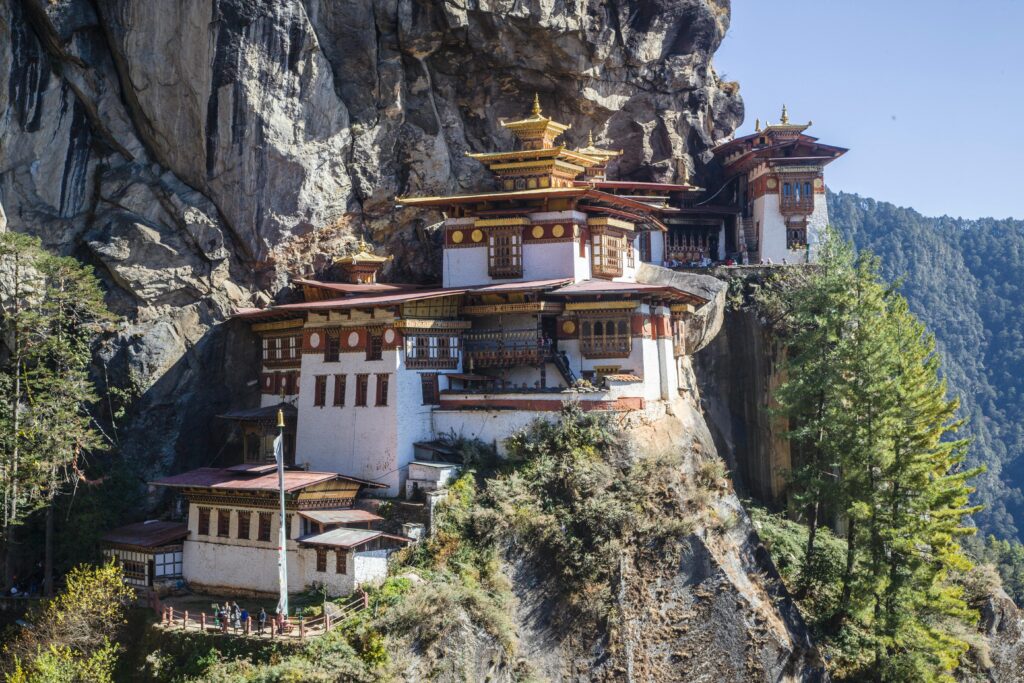
After an early breakfast, embark on a memorable excursion to Taktsang Monastery, famously known as the Tiger’s Nest. Perched on a sheer cliff face at 3,120 meters (10,240 ft), the monastery is one of the most iconic and sacred sites in Bhutan.
Legend has it that in the 8th century, Guru Padmasambhava (Guru Rinpoche) flew to this location on the back of a tigress and meditated in a cave, subduing local spirits and blessing the land. The monastery was later built around this holy site, becoming a place of deep spiritual significance.
The hike takes approximately 5 hours round trip, depending on pace, and ascends through pine forests draped in moss and prayer flags. Midway, a cafeteria provides a rest stop with panoramic views of the monastery clinging to the cliffs.
Although damaged by fire in 1998, Taktsang has been carefully and authentically restored, preserving its spiritual aura and architectural beauty.
Overnight at Hotel in Paro.
Day 09: Paro Airport
Early breakfast in the hotel, then drive to the airport for flight to onward destination.
Please note that some of the sights/itinerary may change due to season, weather, national holidays, and special events. We maintain the rights to alter the itinerary since tours are made in advance and unforeseen circumstances that mandate change may arise. Itinerary changes are made to improve your overall travel experience in Bhutan.
What is included
- will update soon
What is not included
- Will update soon